Showing posts with label Future of Science. Show all posts

Wednesday, June 5, 2019

CRISPR - The What, How and Why...

I gave a talk on CRISPR - A Gene editing tool under the auspices of Varahamihira Science Forum on 25th May 2019 at Tamil Virtual Academy, Kotturpuram, Chennai.

Background: There is so much excitement and apprehension about this in the scientific community. As a person who follows the developments in science and technology to the best of my ability, i wanted to know more about CRISPR and purchased Jeniffer Doudna's 'A Crack in Creation'.

Jeniffer Doudna is a leading figure in the CRISPR revolution and in 2012,  she along with Emmanuelle Charpentier were the first to propose that CRISPR/Cas9 enzymes from bacteria could be used for programmable editing of genomes.  

After reading the book and more articles , I understood why people were excited and apprehensive about CRISPR, all at the same time. Thought that it would be a good idea to talk about this to general public so more people are aware of what CRISPR is and why we , the general public, need to be aware of the technique , so we can make sense out of articles in news magazines or legislations/ guidelines government have come out with or may in the future.

---------------------------------------------------------------------------------------

CRISPR - What is it ? How does it work ? Why do we need this conversation ? 


Purpose of the talk was to provide a high level overview of CRISPR - a targeted gene editing technique , potential applications and the ethical questions that we as a society need to face. In the process answer the above questions.

Objective of the talk was to help the lay person make sense of CRISPR and better understand the news items, debates and articles surrounding the same. Through reference to articles and books, it also aims to be a launch pad for people who wants to explore CRISPR further.


---------------------------------------------------------------------------------------

Here is the video of the talk.


Here is a link to the presentation i used for the talk. It has got references to the data i shared in the talk and also mentions the books and links for further study.


https://drive.google.com/file/d/1F6SJnH6HAO_xpHjoG8l4vh1YX5fRN9L7/view?

I also thank Varahamihira Science Forum, a group that is doing yeomen service in popularising science to the common folks, for giving me this opportunity to talk about CRISPR and to all the people who attended the talk in person/ watched on youtube and came back to me with questions and suggestions.

Happy learning.


Monday, March 4, 2019

From Modularity to Emergence - A Primer on the design and #Science of #Complex #Systems.


"Electrical networks, flocking birds, transportation hubs, weather patterns, commercial organisations, swarming robots... Increasingly, many of the systems that we want to engineer or understand are said to be ‘complex’. 

These systems are often considered to be intractable because of their unpredictability, non-linearity, interconnectivity, heterarchy and ‘emergence’. 

Such attributes are often framed as a problem, but can also be exploited to encourage systems to efficiently exhibit intelligent, robust, self-organising behaviours. 

But what does it mean to describe systems as complex? How do these complex systems differ from the more easily understood ‘modular’ systems that we are familiar with? What are the underlying similarities between different systems, whether modular or complex? 

Answering these questions is a first step in approaching the design and science of complexity. However, to do so, it is necessary to look beyond the specifics of any particular system or field of study. 

We need to consider the fundamental nature of systems, looking for a common way to view ostensibly different phenomena."

The document can be accessed here

Tuesday, February 19, 2019

An article on 'Machine Learning Causing Science Crisis' and my response...

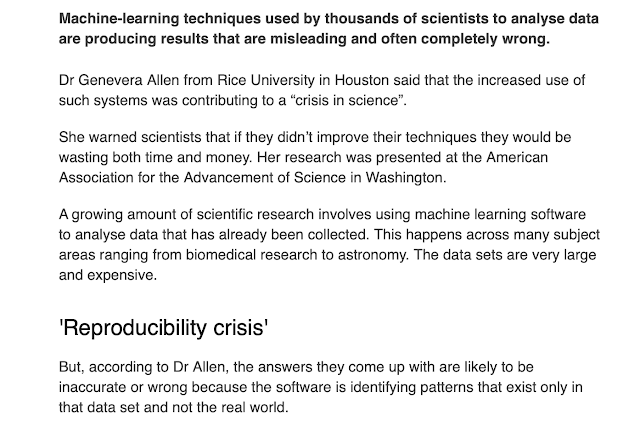
A friend shared an article titled ' 'AAAS: Machine learning 'causing science crisis'. The article is available here


Screen Shot of the Article

Here is my response

Read through the article. it kind of touches upon an interesting area, but quite vague in its coverage.  Need the original paper/talk for more details. I googled, but couldn't get it other than the coverage on other papers like FT.

Here are my comments

1. If the hypothesis that you want to check doesn't align with the results, it is always advisable to change the hypothesis and redo the experiment . Modifying the hypothesis to suit the result is a practice people are not advised to get into. This is a general rule to be followed in data science

2. On the reproducibility crisis, i am sure i will understand it better with an example. right now, looks only a n hypothesis. This statement "“Often these studies are not found out to be inaccurate until there's another real big dataset that someone applies these techniques to and says ‘oh my goodness, the results of these two studies don't overlap‘," she said." simply doesn't make any sense to me  :-) 

3 the word 'reproduction' is bit dicey here. if ML suggests a pattern, what will be needed is to verify it using an independent experimental set up. In the absence of which for whatever reason - like a clear articulation of the problem to be verified, the cost of building the whole experimental study and many such factors - the pattern may just be that - generating such a pattern from another data set may not help much in this regard - other than strengthening the presence of a pattern, subject to terms and conditions


3.1 The Pattern has to be still verified independently in science and in business we need to see if the pattern makes any sense and is of use to us. Such experiments cost money and we have to be careful about where we spend our money in both science as well as business 

4. I recall - from a talk on gravity waves at Anna Centenary Library, Chennai- how setting up an observational set up in outer space takes time and needs lot of money - so experiment will always be behind hypothesis 

5. I personally feel that AI can help identify newer theories in areas like Gravitational waves or astronomy - and scientists should learn to look at it as an enabler 

6. We will see more / hear more on this area in the coming months/ years